Tinnitus Is Not Only a Sound: What One Patient’s Voice Taught Me About Listening, Stress, and the Body
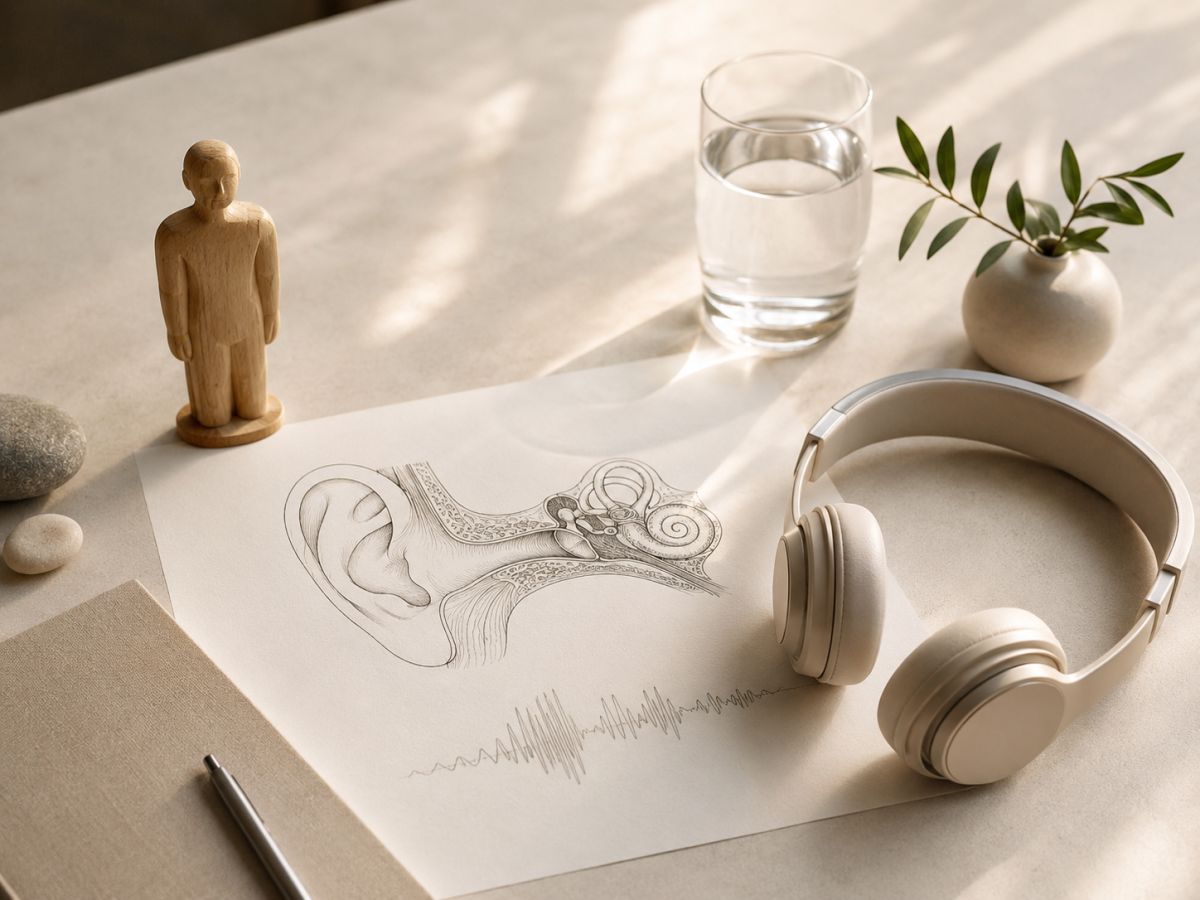
In my work with tinnitus, I do not begin with the ear alone. I begin with the person who hears.
This distinction matters. Tinnitus is commonly described as a ringing, buzzing, humming, hissing, or roaring sound that is perceived without an external source. But clinically, the sound itself is only one part of the patient’s suffering. The more important question is often: what does the sound do to the person’s life?
Does it disturb sleep?
Does it increase fear?
Does it interrupt concentration?
Does it become louder in silence?
Does it create the feeling that the body is no longer trustworthy?
Does it make the patient listen inward all day, searching for danger?
This is why, in my thesis, tinnitus is not treated only as an acoustic phenomenon. It is also a problem of perception, attention, emotional burden, nervous-system regulation, and meaning.
The thesis explicitly argues against dividing human experience into separate systems called “body,” “psyche,” and “consciousness,” and instead describes them as one system viewed from different perspectives.
That does not mean tinnitus is “imaginary.” It means the patient’s experience is larger than the sound.
Modern medical sources support this cautious view. The U.S. National Institute on Deafness and Other Communication Disorders explains that tinnitus can vary from person to person and that there is currently no universal cure, but symptom management may include sound therapy, behavioral therapies, hearing aids, and medications when appropriate.
So my thesis is this:
To help a patient with tinnitus, we must not only ask what the ear hears. We must ask how the whole person is listening.
The story: a colleague who lost parts of her voice
One of the most meaningful encounters in the thesis involved a pastoral-care colleague at Kaiserslautern Hospital. She reported that she could no longer sing in the choir as she had done before. After a viral infection, her voice had partly recovered, but not fully. Some frequencies in her vocal range were missing, and this loss was clearly audible.
She also had tinnitus. The sound had been present on the left side for a long time, and a newer sound had begun on the right side. The tinnitus did not disturb her everyday life severely, but it became especially annoying in external silence.
I asked whether I could demonstrate hypnosystemic techniques using these symptoms. She agreed. This detail is essential: therapeutic work, especially when it uses unusual methods, must begin with consent. In the thesis, this principle appears repeatedly as “no work without a mandate.”
We began with the voice.
I asked her to imagine that the part of herself with the rough, cracking voice could step out of her. Where would that person stand? What posture would she have? What would her face look like?
As she explored this image, her actual voice began to sound clearer, stronger, and more resonant. She noticed the change herself.
But not all frequencies had returned. So we continued. I asked how many “people” inside her might be missing a frequency in the voice. Did they look like her? Were they younger? Did they belong to particular periods of life? Did those ages carry stresses that might have contributed to the loss of vocal expression?
According to the thesis account, using these and similar techniques, her voice was largely restored within about twenty minutes.
Then we turned to the tinnitus.
We started with the newer sound on the right side. I asked whether there was a person inside her who heard the sound, and where that person would stand. Then I asked whether there were also inner figures producing the sound. We looked at their posture, expression, age, and possible connection to earlier experiences.
She reported that the tinnitus in the right ear had already reduced significantly.
Then I asked permission for something even stranger: may I pull the tinnitus out of your ear?
She agreed.
I mimed pulling the sound out as if it were a string. I asked what color the sound had, and how it changed as it was pulled. She described it as blue, becoming paler and more transparent, like a string becoming thinner, smoother, and finally disappearing. With the string, the sound disappeared as well.
The left ear was different. There were more inner figures, more partial sounds, more complexity. Some figures seemed to represent her at different life stages; others were relatives or unknown people.
The sound could also be pulled out as a colored rope, but it changed more slowly. Eventually, the rope frayed and only some strands continued.
After about ninety minutes, the right-sided tinnitus had disappeared, while the left-sided tinnitus had become narrower in sound spectrum and somewhat quieter, but was still clearly present. Over the following weeks, part of the left-sided tinnitus returned; the improvement in the right ear and the voice remained stable.
What this story shows, and what it does not show
Scientifically, this story must be read carefully.
It does not prove that tinnitus can always be removed by imagery.
It does not prove that every patient’s tinnitus comes from psychological conflict.
It does not replace ENT assessment, audiology, or medical treatment.
It does not justify promising a cure.
What it does show is more precise:
A symptom may change when the patient’s attention, imagery, body perception, emotional memory, and sense of agency change together.
This is clinically important because tinnitus is not measured only by loudness. A patient may have a relatively quiet tinnitus that is extremely distressing, or a louder tinnitus that is tolerable.
Hammel’s thesis discusses the Goebel-Hiller Tinnitus Questionnaire as an instrument for assessing the burden of tinnitus, including emotional distress, cognitive impairment, intrusiveness, sleep disturbance, social impairment, and somatic complaints.
That is also consistent with modern tinnitus care. Cochrane’s review of cognitive behavioral therapy for tinnitus found evidence that CBT may reduce the negative impact of tinnitus on quality of life, while evidence for reducing subjective loudness is absent or limited.
This is a central point for Vitaminati readers:
The goal is not always to erase the sound. Sometimes the first therapeutic goal is to reduce the suffering around the sound.
Why the voice matters in this story
The colleague did not come only with tinnitus. She came with a damaged relationship to her own voice.
This matters because voice is not merely sound. Voice is expression, identity, presence, communication, and professional function. For a person who sings in a choir and works in pastoral care, losing parts of the voice can feel like losing access to oneself.
The thesis does not allow us to claim a simple cause-and-effect relationship between voice problems and tinnitus. That would be guessing. But the story does show that, in this case, voice and tinnitus were treated together because they appeared together in the patient’s lived experience.
This is clinically wise.
When a patient presents with tinnitus, we should not ask only about the sound. We should ask:
- What else changed around the same time?
- Was there hearing loss?
- Was there illness, infection, stress, grief, trauma, medication exposure, or noise exposure?
- Is sleep affected?
- Is the jaw tense?
- Is the neck tense?
- Is the voice affected?
- Is concentration affected?
- Is mood affected?
Some of these questions belong to medical assessment. Some belong to psychological assessment. Some belong to the patient’s story. None should be dismissed.
The scientific frame: tinnitus is real, and distress is real too
One danger in body–mind medicine is that people misunderstand it as blame. They hear, “Your symptom is connected to stress,” and they feel accused: “So you think I caused this?”
That is not the point.
A scientific body–mind approach does not blame the patient. It recognizes that the nervous system is biological. Stress is biological. Attention is biological. Sleep is biological. Fear is biological. Hearing is biological.
The brain does not separate “physical” and “emotional” experience as neatly as textbooks sometimes do.
Hammel’s thesis cites literature connecting tinnitus with psychiatric symptoms, especially anxiety, depression, stress, and insomnia. It also notes that stress, depression, insomnia, anxiety, and tension may amplify tinnitus, and that risk of persistent tinnitus may be higher when psychosocial stress, anxiety, sleep disorders, or dissatisfaction with life are present at the onset.
This does not mean stress is always the cause. It means stress can be part of the system in which tinnitus becomes more intrusive.
Because the nervous system can be part of the tinnitus experience, readers may also find it useful to understand the broader relationship between magnesium, stress, and the nervous system. This should be understood carefully: magnesium, or any supplement, should not be presented as a proven treatment for tinnitus.
Current guidance also treats tinnitus as a condition requiring careful assessment and support. NICE guidance covers assessment, investigation, and management of tinnitus across primary, community, and secondary care, and recommends urgent referral when tinnitus is associated with sudden hearing loss.
What patients can learn from this story
The most important lesson is not “pull the tinnitus out like a string.” That method belongs to a trained therapeutic context and should not be presented as a universal self-treatment.
The lesson is deeper:
The way a patient relates to tinnitus can change.
A patient may move from fear to observation.
From fighting the sound to understanding the pattern.
From helplessness to participation.
From “my ear is attacking me” to “my nervous system may be asking for regulation.”
From “nothing can be done” to “something can be done to reduce the burden.”
This distinction is supported by tinnitus treatment research. CBT is not considered a cure for tinnitus, but it can help people change their response to tinnitus-related thoughts and distress.
The American Academy of Audiology emphasizes that “no cure” does not mean “no treatment,” and warns that telling patients “nothing can be done” can harm coping.
For Vitaminati readers, this is a valuable and safe message:
- Tinnitus should be medically evaluated.
- Hearing health should be protected.
- Sleep and stress should be taken seriously.
- Mental health support may be part of tinnitus care.
- The patient should not be left alone with the sentence: “Just live with it.”
A careful note on supplements and tinnitus
No vitamin, mineral, herb, or supplement should be presented as a proven cure for tinnitus. Some nutritional deficiencies, such as vitamin B12 deficiency, can affect the nervous system, and general nutrient adequacy is important for health. But it would be scientifically inaccurate to tell readers that supplements can reliably stop tinnitus.
If a reader also experiences fatigue, low energy, or symptoms that may suggest a nutritional gap, Vitaminati’s article on vitamins for energy and fatigue may provide general background. This should not replace medical evaluation for tinnitus.
A responsible approach is this:
- If tinnitus is present, first seek appropriate medical evaluation.
- If there are signs of deficiency, test and correct them under professional guidance.
- If sleep, anxiety, or stress are present, address them as part of a broader care plan.
- If hearing loss is present, audiology assessment and hearing aids may help some patients.
- If distress is high, CBT or other evidence-based psychological support may be useful.
This keeps the message honest and medically safe.
Sleep and stress: why they should be taken seriously
Tinnitus may become more noticeable in silence or before sleep, and anxiety about the sound may make sleep harder. Improving sleep habits is not a cure for tinnitus, but it may help some people reduce the daily burden associated with it.
If sleep is affected by stress or overthinking, readers can review Vitaminati’s article on tips to help you fall asleep as general lifestyle education. Medical care is still important if tinnitus is new, severe, one-sided, pulsatile, or linked with hearing loss.
Final reflection
In the story of my colleague, the right-sided tinnitus changed quickly, while the older left-sided tinnitus changed only partially. This difference matters. It reminds us that symptoms have history. Some are recent, flexible, and responsive. Others are older, layered, and more complex.
A scientific therapeutic approach must respect that complexity.
Not every sound disappears.
Not every story produces change.
Not every patient responds in the same way.
But sometimes, when a patient is invited to listen differently — not only with the ear, but with the whole person — the symptom loses some of its power.
And sometimes, before silence returns, something else returns first:
the voice.
Medical note
This article is educational and does not replace professional care. Seek urgent medical evaluation if tinnitus begins suddenly, is one-sided, is pulsatile, follows injury, is associated with sudden hearing loss, dizziness, neurological symptoms, severe headache, or major mental distress. NICE specifically recommends urgent referral when tinnitus is associated with hearing loss that developed suddenly within 3 days in the past 30 days.
Sources used in this blog
- Stefan Hammel thesis — Introduction, body–mind unity: used for the concept that body, psyche, and consciousness are one system viewed from different perspectives.
- Stefan Hammel thesis — Section 2.5, colleague with voice problems and tinnitus: used for the full story of the pastoral-care colleague, voice loss, right-sided and left-sided tinnitus, and the “string” imagery.
- Stefan Hammel thesis — tinnitus burden questionnaire: used for the idea that tinnitus burden includes emotional distress, concentration, intrusiveness, sleep, social life, and somatic complaints.
- Stefan Hammel thesis — stress, insomnia, anxiety, depression and tinnitus: used for the cautious link between tinnitus and stress-related or psychiatric symptoms.
- NIDCD / NIH — Tinnitus: used for medical framing that tinnitus has no universal cure, but symptoms may be managed through approaches such as sound therapy and behavioral therapies.
- NICE — Tinnitus: assessment and management: used for referral and medical-safety framing.
- Cochrane — Cognitive behavioural therapy for adults with tinnitus: used for the claim that CBT may reduce tinnitus impact and quality-of-life burden more clearly than subjective loudness.
- American Academy of Audiology — Cognitive Behavioral Therapy for Tinnitus: used for the statement that “no cure” does not mean “no treatment,” and that CBT is not a cure but can help patients cope.