Mucuna Pruriens (Velvet Bean): Benefits, Uses, and Side Effects
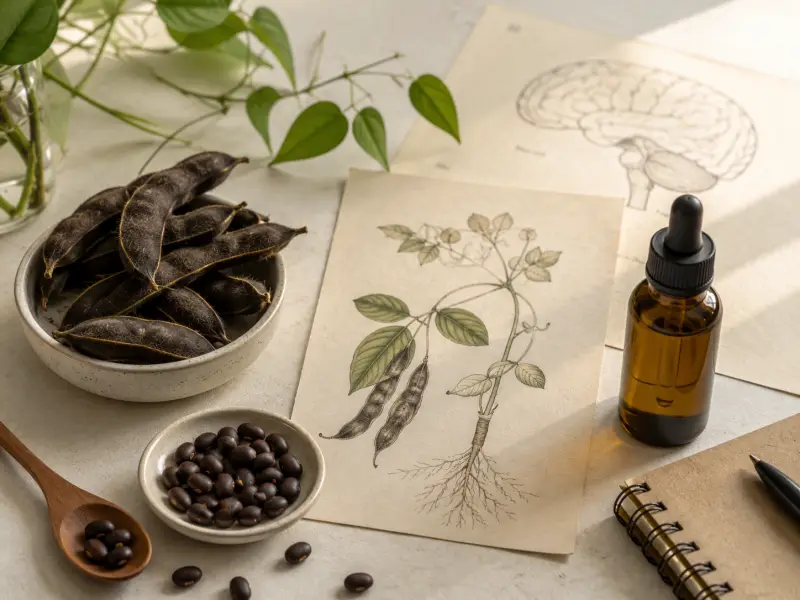
Mucuna Pruriens: Velvet Bean, Dopamine, Benefits, and Safety
Mucuna pruriens, also known as velvet bean, is a tropical legume best known for naturally containing L-dopa, a compound involved in the body’s dopamine pathway. Because dopamine plays a role in movement, motivation, mood, and focus, Mucuna pruriens is often discussed in relation to brain health, mental performance, and Parkinson’s disease.
However, Mucuna pruriens should not be treated like a simple wellness supplement. Its L-dopa content gives it a potentially drug-like effect, which means it may interact with Parkinson’s medications, psychiatric medications, blood pressure drugs, and certain health conditions. This guide explains its possible benefits, scientific limits, side effects, and safe-use precautions.
Quick Summary: What Should You Know About Mucuna Pruriens?
- Mucuna pruriens is a tropical legume also known as velvet bean.
- Its seeds naturally contain L-dopa, a compound involved in dopamine production.
- It has been studied in Parkinson’s disease, but the evidence is still limited and does not support replacing medical treatment.
- Possible side effects include nausea, dizziness, insomnia, abnormal movements, mood changes, and digestive discomfort.
- It should not be combined with Parkinson’s medications or psychiatric medications without medical supervision.
- It is best avoided during pregnancy, breastfeeding, liver disease, kidney disease, or before surgery unless a clinician advises otherwise.
What Is Mucuna Pruriens?
Mucuna pruriens is a climbing legume that grows in tropical and subtropical regions, including parts of Asia, Africa, and Latin America. It is commonly called velvet bean because of the fine hairs that cover its pods.
The plant has a long history of use in traditional systems such as Ayurveda, especially for concerns related to movement, vitality, and nervous system support. Still, traditional use does not automatically mean that a concentrated supplement is safe for everyone.
The main reason Mucuna pruriens requires caution is its natural L-dopa content. L-dopa is not just a general nutrient; it is a biologically active compound that can influence dopamine-related pathways in the brain and body.
How Is Mucuna Pruriens Connected to Dopamine?
Mucuna pruriens is widely discussed because its seeds contain L-dopa. L-dopa is a precursor to dopamine, a neurotransmitter involved in movement control, motivation, reward, mood, and attention.
However, saying that Mucuna pruriens “boosts dopamine” is an oversimplification. Dopamine is part of a complex neurological system, and changing dopamine-related activity may be inappropriate for some people, especially those taking medications that affect dopamine, serotonin, mood, or movement.
For a broader look at nutrients involved in nervous system balance, Vitaminati’s article on magnesium and the nervous system explains how stress, mood, and cognitive performance depend on more than one pathway.
Mucuna Pruriens Benefits: What Does the Evidence Suggest?
1. It May Support Dopamine Pathways
Because Mucuna pruriens contains L-dopa, it may influence dopamine-related pathways. This is why it appears in some supplements marketed for motivation, mental energy, mood, and focus.
Still, low motivation, fatigue, poor concentration, and low mood can have many causes, including poor sleep, chronic stress, nutrient deficiencies, thyroid problems, medication effects, anxiety, depression, or other medical conditions. Mucuna pruriens should not be used to self-treat these symptoms.
If fatigue or low energy is the main concern, it may be more useful to review Vitaminati’s article on vitamins for energy and fatigue before assuming dopamine is the main issue.
2. Mucuna Pruriens and Parkinson’s Disease
Mucuna pruriens has been studied in Parkinson’s disease because Parkinson’s treatment often involves dopamine-related therapy, and Mucuna seeds naturally contain L-dopa. Some small clinical studies have examined whether Mucuna preparations may affect motor symptoms.
However, this does not mean Mucuna pruriens should be used as a natural replacement for Parkinson’s medication. The evidence remains limited, supplement quality varies, and combining Mucuna with prescribed levodopa or other Parkinson’s medications may increase the risk of side effects.
3. Nervous System and Movement Support
Because of its L-dopa content, Mucuna pruriens is often linked to movement and nervous system support. But the nervous system depends on many nutrients and processes, not dopamine alone.
For example, vitamin B1 plays an important role in energy metabolism and nerve function. You can compare this with Vitaminati’s article on vitamin B1 benefits for the body, which explains a different nutritional route for supporting normal nerve function.
4. Mood and Focus: Is the Evidence Strong Enough?
Some people use Mucuna pruriens for mood, motivation, or focus because dopamine is involved in these functions. However, strong human evidence for using Mucuna pruriens as a mood or focus supplement is still limited.
It should not be used as a replacement for treatment of depression, anxiety, ADHD, bipolar disorder, or any psychiatric condition. In some people, dopamine-active supplements may worsen anxiety, agitation, insomnia, or mood instability.
5. Possible Antioxidant Activity
Mucuna pruriens contains plant compounds that may show antioxidant activity in laboratory or animal research. However, antioxidant activity in early-stage research does not prove that a supplement prevents neurodegenerative disease or protects the brain in humans.
For long-term brain health, the stronger foundation usually includes sleep quality, physical activity, blood pressure control, balanced nutrition, and early evaluation of memory or movement changes. For related reading, see Vitaminati’s article on Alzheimer’s, dementia, early signs, and brain health tips.
Is Mucuna Pruriens Useful for Stress or Sleep?
Mucuna pruriens is not usually the first supplement to consider for stress or sleep. Because it affects dopamine-related pathways, it may feel stimulating for some people and may worsen insomnia, restlessness, or anxiety.
For sleep, relaxation, and stress support, it is usually better to begin with lifestyle basics and lower-risk nutritional approaches. Vitaminati’s article on ashwagandha and magnesium as a calming combination discusses a different supplement approach for stress support, while still requiring caution with herbal products.
Mucuna Pruriens Side Effects
Because Mucuna pruriens contains L-dopa, its side effects may resemble some effects seen with dopamine-related medications, especially at higher doses or when combined with other drugs.
- Nausea or stomach discomfort.
- Dizziness or headache.
- Insomnia, restlessness, or irritability.
- Palpitations or discomfort in sensitive individuals.
- Abnormal involuntary movements in some people, especially with dopamine-related therapies.
- Mood changes, anxiety, confusion, or agitation in susceptible individuals.
Another important concern is product quality. Mucuna supplements may vary in L-dopa concentration, and some products may not match the amount claimed on the label. This makes dosing less predictable than with regulated prescription medications.
Who Should Avoid Mucuna Pruriens?
Mucuna pruriens should be avoided or used only with medical approval in the following situations:
- Pregnancy or breastfeeding.
- Liver disease or kidney disease.
- Parkinson’s disease or use of levodopa-containing medications.
- Use of psychiatric medications or medicines affecting dopamine or serotonin.
- History of psychosis, mania, bipolar disorder, or unstable mood disorders.
- Low blood pressure or use of blood pressure medications.
- Upcoming surgery or use of anesthesia-related medications.
How to Choose a Mucuna Pruriens Supplement
If a qualified healthcare professional recommends Mucuna pruriens, product selection matters. The most important point is not whether the product is “natural,” but whether the label clearly states the amount of L-dopa and whether the manufacturer follows quality standards.
- Choose products that clearly state the standardized L-dopa content.
- Avoid products that promise “instant dopamine,” “natural Parkinson’s treatment,” or guaranteed mood enhancement.
- Do not combine it with other dopamine-active supplements without professional guidance.
- Be cautious with high-strength extracts, especially if you are sensitive to stimulants or mood changes.
- Stop use and seek advice if unusual movement, mood, sleep, or digestive symptoms appear.
What Is the Right Mucuna Pruriens Dosage?
There is no single safe Mucuna pruriens dose that applies to everyone. Products differ in extract strength, L-dopa concentration, preparation method, and quality control.
Unlike standard vitamins with established intake ranges, Mucuna pruriens has a more complex safety profile because of its L-dopa content. The dose should depend on the product, health status, medication use, and the reason for taking it.
For this reason, it is not appropriate to provide a general dosing table for everyone. Medical supervision is especially important for anyone with neurological symptoms, psychiatric history, cardiovascular concerns, or chronic disease.
Where Does Mucuna Pruriens Grow?
Mucuna pruriens grows in tropical and subtropical climates, especially in parts of South Asia, Africa, and Latin America. It is a legume that can adapt to different growing environments and has been used traditionally in both agriculture and herbal medicine.
However, the fact that a plant grows naturally or has traditional use does not mean concentrated extracts are automatically safe. Supplements may deliver much higher or more standardized amounts of active compounds than traditional food or plant preparations.
Frequently Asked Questions About Mucuna Pruriens
Does Mucuna pruriens increase dopamine?
Mucuna pruriens contains L-dopa, a compound involved in dopamine production. Its effect depends on the product, dose, health status, and medications used.
Can Mucuna pruriens treat Parkinson’s disease?
No. It has been studied in Parkinson’s disease, but it should not replace prescribed treatment. Anyone with Parkinson’s should use it only under medical supervision.
Is Mucuna pruriens safe to take every day?
Not for everyone. Daily use may carry risks because of its L-dopa content, especially with long-term use, high doses, or medication interactions.
Can Mucuna pruriens improve mood?
There is not enough strong evidence to recommend it for mood disorders. It should not replace care for depression, anxiety, ADHD, bipolar disorder, or other mental health conditions.
Is Mucuna pruriens safe during pregnancy?
It is best avoided during pregnancy and breastfeeding because safety data are limited and potential risks have been raised by safety authorities.
Does Mucuna pruriens interact with Parkinson’s medications?
Yes, it may interact with levodopa-containing medications and other dopamine-related treatments. Medical supervision is essential.
Is Mucuna pruriens better than prescription levodopa?
No reliable conclusion supports that. Some studies compare Mucuna preparations with levodopa, but supplement consistency, dosing, and medical monitoring remain major concerns.
What makes Mucuna pruriens different from general brain supplements?
Mucuna pruriens naturally contains L-dopa, making it more pharmacologically active than many general nutrient supplements such as B vitamins or magnesium.
Conclusion
Mucuna pruriens is an interesting herbal supplement because it naturally contains L-dopa, which explains its connection to dopamine and movement-related research. However, this same feature makes it a supplement that requires more caution than many general wellness products.
It may have possible benefits in specific research contexts, especially around motor symptoms in Parkinson’s disease, but the evidence is not strong enough to use it as a replacement for medical treatment. Safe use depends on medical history, medication review, product quality, and professional guidance.
This article is for general educational purposes only and does not replace medical advice. Do not use Mucuna pruriens if you are pregnant, breastfeeding, have liver or kidney disease, take Parkinson’s or psychiatric medications, or have a chronic medical condition unless advised by a healthcare professional.